Why a Good Classification Needs a Clear Rule
A clear rule makes leaf classification easier to use: sort a mixed collection consistently, explain uncertain cases and revise the rule when needed.
You have a handful of leaves on the kitchen table: some broad, some narrow, a few with jagged edges and one that is partly torn. A clear rule for leaf classification turns that jumble into an arrangement another person can understand and use, rather than a set of piles whose logic exists only in your head.
A classification is a system for assigning things to groups. Its sorting principle—the feature or question that decides where each item goes—does the real work. Trouble begins when that principle is unstated, shifts halfway through, or cannot be applied to the items in front of you.
Start by naming the question the groups should answer
Before making piles, decide what you want the classification to help someone notice. A set of leaf groups could help a learner compare shapes, organise specimens for a nature walk, or distinguish leaves by their condition. Those are different purposes, so they call for different sorting rules.
For a simple shape-focused arrangement, the rule might be: group leaves by the outline of the blade, the broad, flat part of a leaf. The midrib and veins, colour, and signs of damage may still be interesting, but they do not decide the group. That boundary matters because a rule is useful only when it makes clear which features count.
If the purpose is unclear, people often reach for whatever feature catches the eye first. The result can be a mixture of colour groups, size groups and shape groups. Try writing the intended question as a short sentence before sorting: “Which leaves have a smooth edge, and which have a toothed edge?”
Separate mixed rules before they create contradictory piles
A common problem is that one item seems to belong in several places. A small, yellow leaf with a smooth edge could fit a colour pile, a size pile and an edge-shape pile at once. That is not a defect in the leaf; it is a sign that several possible classification rules are competing.
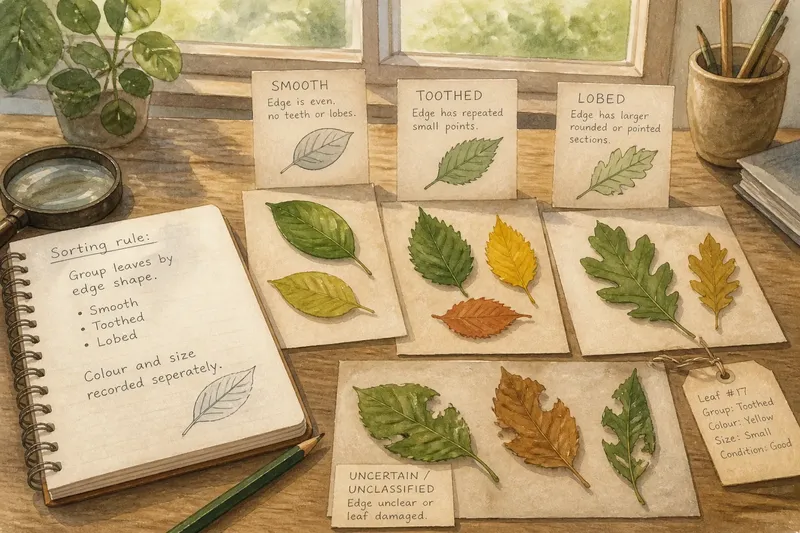
Choose one feature for the first grouping. If you choose edge shape, make categories such as smooth, toothed and lobed, where lobes are larger rounded or pointed sections of the outline. Do not put colour into the group names as well. You can record colour separately on a label or in a note, without making it part of the sorting decision.
Say you are arranging leaves for a child who is learning to notice edges. You choose smooth, toothed and lobed as the groups, then find a small leaf that is both yellow and toothed. Under the stated rule, it goes in toothed; the yellow colour can be written on its card. The expected observable result is that someone else can place another toothed leaf without asking which feature matters more.
Give every category a boundary that can be applied
Vague category names such as “unusual” or “ordinary” make sorting depend on personal judgement. Even descriptive terms can be slippery: one person may call an edge “slightly toothed”, while another sees it as smooth. The rule needs enough detail to help with the borderline cases that are likely to occur.
For a small leaf collection, you might define a toothed edge as one with repeated small points along it, and a lobed leaf as one whose outline has larger sections separated by noticeable indentations. These are working definitions, not claims about every plant. If the collection includes leaves that do not fit, add a temporary “uncertain” place rather than forcing a dubious choice.
Then inspect the uncertain group. If its members share a feature that the original categories overlooked, refine the definitions or add a category. If the leaves are simply torn or too damaged to judge, mark that limitation. A classification should make uncertainty visible, not disguise it as confidence.
What should happen when a leaf fits two groups?
Can one item belong to more than one category?
It can, if the system is designed to allow multiple labels. But if the aim is one item in one pile, state which feature takes priority and apply it consistently. Otherwise, people will make different choices for the same reason.
What if a leaf does not fit any category?
Set it aside as uncertain or unclassified while you check whether the rule or the item is the source of the mismatch. If several leaves share the same overlooked feature, revise the categories; if a leaf is damaged, note that rather than inventing a fit.
Should size or colour be included in the rule?
Include either only if it serves the purpose of the classification. When shape is the organising principle, size and colour can remain as separate observations, so they do not quietly change the membership rule.
How can I tell if another person understands the rule?
Give them an unsorted leaf and the written rule, then ask them to place it and explain why. If their decision differs from yours, clarify the category boundaries or the intended priority instead of treating the disagreement as carelessness.
Check that categories cover the collection without overlapping by accident
Two faults often appear together: a leaf seems to fit two categories, or no category seems suitable. Overlap may mean that the categories were defined on different grounds; a gap may mean that the rule is too narrow or that an item lacks the feature needed to decide. Look at the category names and ask whether each describes the same kind of distinction.
For example, “smooth edge” and “toothed edge” both describe outlines, while “large leaf” introduces size. A system combining those labels has no consistent basis for deciding where a large toothed leaf belongs. Keep categories on the same level: all about edge form, or all about size, rather than a mixture.
It can also help to check a few contrasting items: a clear smooth-edged leaf, a plainly toothed one, and a borderline or damaged leaf. These are not a formal test of the whole system; they are a way to spot wording that fails on ordinary cases. If you cannot explain a placement in one sentence using the rule, pause before adding more categories.
Revise the rule without losing the reason for earlier decisions
Sometimes a classification becomes less useful as the collection grows. Perhaps you began with smooth and toothed edges, then found leaves with broad lobes that neither group describes well. The response is not to quietly stretch “toothed” until it includes them; that would make the original rule harder to interpret.
Instead, state the revised categories and check the earlier leaves against them. If the purpose is still to compare edge shapes, adding a lobed category may resolve the gap. Keep a brief note of the change, such as “Lobed leaves separated from toothed leaves after the first sort”, so a reader can understand why the arrangement changed.
Use this same sequence when a classification stalls: identify the intended question, choose one deciding feature, define category boundaries, set aside genuine uncertainty, and review overlaps or gaps. A good classification is not one that eliminates every difficult case. It is one whose rule lets people make ordinary decisions consistently and see where judgement is still required.
For leaf classification, the clearest arrangement is often the one with the fewest assumptions: a visible feature, names that describe it, and a note for exceptions. Before adding another category, ask whether it answers the original question or introduces a second one. That small pause keeps the piles useful after someone else joins the table.